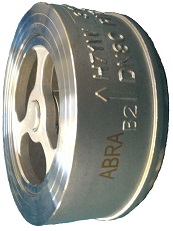
Wafer type disc check valve from AISI316 (CF8M) DN15-300 PN25 ABRA-D71
Share the link with your colleagues:
Wafer type disc check valve from AISI316 (CF8M) DN15-300 PN25 ABRA-D71
Check valve is not deigned and should not ever be used as shut-of valve. Lakage rate - rate B according ISO 5208, GOST54808 and GOST 9544 at pressure drop of 1,1PN
Main fields of application - the valve is used as shut-off (on-off) in the following applications:
Any systems with the following working medias:
water including seawater, technical, potable, drinking, district heating water, distilled, purified e.t.c.
salt brines, salt liquors, saline solutions; salt solutions
water steam (up to 8 bar),
air, compressed air and neutral gases,
natural gas, Freons, cooling agents - gaseous
alcohols, acetic acid (vinegar, ethanoic acid, spirit of verdigris, acetous acid), pure, mixes and solutions
antifreezes including water glycol mixtures,
ammonia (hydrogen nitride),
moderate aggressive acids
all bases and alkali liquors
light and heavy petroleum products
other medias corresponding to material properties
cold water supply
hot water supply
district heating with any standard heat carrier (including antifreezes and non-freezing solutions)
steam lines up to 200°C,
condensate loops and lines,
technical water supply,
neutral and noble gas pipelines including natural gas,
water treatment and water intake,
mineral and synthetic oils transportation e.t.c.
Outline drawing of wafer type disc check valve ABRA-D71:
Check Valves symbols for piping and instrumentation diagram (P&ID):
Variant1. Check valve symbol. Arrow shows the flow direction.
Just Informative. Angle check valve symbol. Arrow shows the flow direction.
Dimentions, technical characteristics, weight, Kv and Cv - wafer type disc check valve ABRA-D71. Dimentions in mm. Table
DN
15
20
25
32
40
50
65
80
100
125
150
200
250
300
1/2"
3/4"
1"
1 1/4"
1 1/2"
2"
2 1/2"
3"
4"
5"
6"
8"
10"
12"
PN
25bar (2,5 MPa)
Temperature range °C
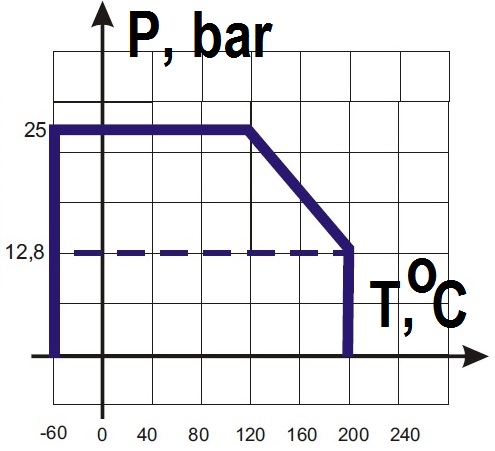
Maximum short time temperature: 200 °C,
Minimal ambient temperature: - 60 °C,
Code
ABRA-D71-
-H71W-16/25-
-015
ABRA-D71-
-H71W-16/25-
-020
ABRA-D71-
-H71W-16/25-
-025
ABRA-D71-
-H71W-16/25-
-032
ABRA-D71-
-H71W-16/25-
-040
ABRA-D71-
-H71W-16/25-
-050
ABRA-D71-
-H71W-16/25-
-065
ABRA-D71-
-H71W-16/25-
-080
ABRA-D71-
-H71W-16/25-
-100
ABRA-D71-
-H71W-16/25-
-125
ABRA-D71-
-H71W-16/25-
-150
ABRA-D71-
-H71W-16/25-
-200
ABRA-D71-
-H71W-16/25-
-250
ABRA-D71-
-H71W-16/25-
-300
L - installation length, mm
27,5
28
28
30
36
40
49
57
68,5
78,5
95
108
132
150
øD-outside diameter, mm
51
61
70
79
88
108
125
137,5
166,5
191
221
267
320
380
ød, mm
15
20
25
32
40
50
65
80
100
125
150
200
250
300
Weight, kg
0,275
0,280
0,380
0,500
0,640
1,000
1,600
2,250
2,900
4,400
6,500
8,000
24,500
35,000
Кv, m3/h (Cv=1,17 Kv)
2,5
5
9
18
29
45
75
115
190
320
380
550
900
1350
Opening pressure MPa
0,03-0,05 = 3-5 wcm
Minimum stud length for wafer mounting , mm
105
105
105
110
120
120
150
160
180
200
215
240
250
280
Minimum bolt length for wafer mounting , mm
80
80
80
90
100
110
120
130
150
170
185
210
230
250
Construction - wafer type disc check valve ABRA-D71:
N
Description
Qnt.
Matherial
1
Body
1
Stainless steel Grade CF8M = W.-nr.1,4401 = DINX5CrNiMo17-12-2 = BS316S16 =EN 58J = AFNOR Z6CND17.11 = UNI X5CrNiMo1712 = UNE F.3543 = SS2347 = GB 0Cr17Ni11Mo2 = AISI/SAE 316 = JIS SUS 316 = GOST03Х17Н14М2
2
Disc
1
Stainless steel AISI/SAE SS 316
3
Spring
1
Stainless steel AISI/SAE SS 316
4
Body
1
Stainless steel AISI/SAE SS 316
Pressure / Temperature diagram for wafer type disc check valve ABRA-D71:
Diagram defines working pressure/tempetarure range for check valve ABRA-D71
Connection flanges standards :
STANDARD
Notes
Suitable types to that standard
PN for connection flanges
DN for connection flanges
EN 1092-1
Flange coupling dimensions and sealing surfaces - "new" EU flange standard
Form A, Form B (B1 and B2) - for sealing surface (common "flat" flanges ) Type - all types if Form as above
PN25/PN16/PN10
The same as DN of ABRA check valve
DIN 2526
Flange coupling dimensions and sealing surfaces - "old one"
Form A, B, C, D, E (common "flat" flanges )
GOST 33259, GOST Р 54432
Flange coupling dimensions and sealing surfaces - new Russian flange standards
All types (Type 01,Type 02, Type 03, Type 04, Type 11, Type 21), Forms only A and B. (common "flat" flanges )
PN2,5/1,6/1,0 MPa = PN25/PN16/PN10 kg/cm2
GOST 12815
Flange coupling dimensions and sealing surfaces - "USSR old one"
Variant 1, range 1, range 2 for all DN. (common "flat" flanges )
Installation and maintenance instruction for - wafer type disc check valve ABRA-D71
General.
At correct assembly, maintenance and repair we guarantee a trouble-free function. If the installation and maintenance instruction is not followed correctly, the manufacturer is not responsible for the efficiency and safety of the valves. The valves must not be operated above the limits and rules indicated in the different documents (e.g. operation rules, purchase documents, datasheets). Operation above the indicated limitations can damage the valves and finally destroy them.
All work must be carried out or be supervised by a suitably competent person. Installation and operating personnel should be trained in the correct use of the product according to the Installation and Maintenance Instructions. Where a formal 'permit to work' system is in force it must be complied with. Where there is no such system, it is recommended that a responsible person should know what work is going on and, where necessary, arrange to have an assistant whose primary responsibility is safety. Post 'warning notices' if necessary.
Any modification of the valves has to be accepted and agreed by the Seller. The use of original spare parts and accessories which are authorized by the manufacturer supports the function and safety. If any damage is caused by using other parts the indemnity and warranty can be refused.
The valves are delivered ready for installation and operation. During transport , make sure that the valves retain their mechanical protection. The transport must take place with suitable transport boxes (e.g. wooden boxes) . The valves must be secured in the transport boxes against crushing and tilting. Otherwise the valves may be damaged.
Before mounting you should check the valve for transportation or storage damage. If you find that you should stop mounting until you get Seller's approval.
Check valves are not deisgned and should not ever be used as shut-of valve. Lakage rate - rate B accoding ISO 5208 nad GOST54808 and GOST 9544
Disc check valves are not suitable for use where heavily pulsating flow exists, such as close to a compressor.
Before mounting consider hazardous liquids or gases in the pipeline i.e. - what is in the pipeline or what may have been in the pipeline at some previous time. Consider: flammable materials, substances hazardous to health, extremes of temperature.
Before monting consider hazardous environment around the product i.e. - Consider: explosion risk areas, lack of oxygen (e.g. tanks, pits), dangerous gases, extremes of temperature, hot surfaces, fire hazard (e.g. during welding), excessive noise, moving machinery. Consider the effect on the complete system of the work proposed. Will any proposed action (e.g. closing isolation valves, electrical isolation) put any other part of the system or any personnel at risk? Dangers might include isolation of vents or protective devices or the rendering ineffective of controls or alarms. Ensure isolation valves are turned on and off in a gradual way to avoid system shocks. Ensure that any pressure is isolated and safely vented to atmospheric pressure. Consider double isolation (double block and bleed) and the locking or labelling of closed valves. Do not assume that the system has depressurised even when the pressure gauge indicates zero. Allow time for temperature to normalise after isolation to avoid the danger of burns and consider whether protective clothing (including safety glasses) is required.
Before starting work ensure that you have suitable tools and/or consumables available. Use only genuine ABRA replacement parts. Consider whether you and/or others in the vicinity require any protective clothing to protect against the hazards of, for example, chemicals, high/low temperature, radiation, noise, falling objects, and dangers to eyes and face.
Before installation, the pipe must be cleaned. If necessary, strainers must be cleaned from dirt and dust too.
During installation in the pipeline, flanges of the pipeline must be exactly parallel to flange connections of the strainer. In addition the direction - arrow must show into flow direction.
The valve can be mounted on the vertical, inclined and horizontal pipelines. It is required to ensure sufficient space around the check valve for future service work if that will be ever necessary.
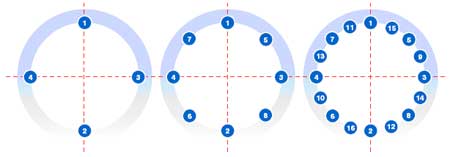
Flange connection screws are tightened with a torque spanner (Torques according to EN921 - 934 or ISO4732, 4032, 4017 etc.) Tighten the screws in a crosswise sequence. Flanges rods or bolts should be tightened in evenly cross-cross way in three or four passes as shown on the picture:
If tightening load in flange connection is weakening due to relaxation in gasket or fixture, or in case when technological process is very cyclic in pressure or temperature the additional tightening of flange connection could be necessary. In most heavy cases (very-very rare) using strong cap washers can help.
Maintenance.
Check valves ABRA-D71 do not require constant maintenance. Parts are insoluble in aquatic media.
Periodically inspect the valve for fluid leaks.
Leakage (e.g. at stem, at gaskets) of dangerous medias (explosive, toxic, hot) has to be removed in a way that no danger to persons or environment is given. Trouble-shooting must be started and failure has to be solved.
Injuries danger by electricity have to be excluded (please always consider the details of this subject in the local guidelines for the power supply companies).
Valves for higher or lower temperatures ( >50°C or < 0°C ) are to be protected against unintended direct contact (e.g. isolation) or at least to be indicated clearly with a warning signs.
Additionally please note that the evaporation temperature of the media must be lower than the temperature of all wetted parts of the strainer.
Provision must be made to protect products which are not self-draining against frost damage in environments where they may be exposed to temperatures below freezing point.
Valve check out can be carried out when replacing pipelines.
Valves which get in touch with health injuring media have to be decontaminated any time you have to work with them. Immediately after the work is done, all safety and protection devices have to be put in place back again.
For quick cleaning of the strainer bowl the bonnet plug can be used. The bonnet and the bonnet plug can be opened only when the system is shut-off, and standing without pressure. Take care about temperature too.
The mesh has to be cleaned periodically. Depending on the quality of working media and protected equipment service demands mesh should be cleaned not less than once per year. If the mesh size is less than 0,8 mm we recommend cleaning not less than twice per year. For a new installation or even after a maintenance all pipes have to be flushed and cleaned. Dirt, welding beads and other dirt particles could result in a malfunction, but at least result in a less powerful strainer.
For full strainer cleaning the mesh should be extracted and washed. Prior (re)assembly of the cover, the valve body has to be cooled down. Use a new cover sealing! Put the screen into the body in a released condition and put the cover on it. It is important that the cover sealing is centered correctly and free of any kind of dirt. Subsequently, please tighten the screws in a crosswise sequence acc. to the applicable technical guidelines. Please check the tightness of the strainer.
Transportation and Storage.
Transportation and storage should be made without shocks at temperature: -60…+65 °С.
Aids for lifting and transport in the plant have to be installed always directly on the body of the valve. Preferably, the transport should be done in horizontal position. Head protection is mandatory
The connections must be covered to prevent the penetration of dirt and dust (preferably with the delivered flange caps). The strainers have to be stored dry and well ventilated. For long-term storage, the strainers must be checked and cleaned periodically . Machined surfaces must be protected by appropriate aids against corrosion .
The strainers must be stored in prеmіsеs protected against influences of weather and environment
Attention!
Due to the process inline whenever some hot or cold valve or strainer parts could be touched, it may cause injuries. It must be assured that the parts are constructed in a way that they are protected from contacts. The contact protection for moving parts (e.g. coupling ) must not be taken during operation.
The opening of the valve or strainer under pressure can be deadly! Generally, any kind of work at the valves can only be done during plant shut - down.
Generally, any work at the strainer is only allowed if the valve is cooled down and with no pressure inside.
Don't remove factory marking from the strainer body.
Guarantee.
Guarantee is 12 month from installation but not more than 18 month from shipment if all demands of this manual are fulfilled.
Customers and stockists are reminded that under EC Health, Safety and Environment Law, when returning products to ABRA they must provide information on any hazards and the precautions to be taken due to contamination residues or mechanical damage which may present a health, safety or environmental risk. This information must be provided in writing including Health and Safety data sheets relating to any substances identified as hazardous or potentially hazardous.
Please note! ABRADOX can accept no responsibility for possible errors in catalogues, brochures and other published materials. ABRADOX reserves the right to alter its products without notice. This also applies to products already on order provided that such alterations can be made without subsequential changes being necessary in specifications already agreed. All trademarks in this material are property of the respective companies and are not allowed to be used without the prior written permission of ABRADOX.